a conversation in madrid
When my friend visited me in Madrid last September, we talked a lot about Spanish media and how its coverage of the genocide in Gaza felt completely different from what she saw back home in Italy.
She was shocked by how emotional the reporting was; the media seemed genuinely invested in the Palestinian cause.
Of course, I had to tell her she was only getting one side of the story. During her stay, she’d only been watching RTVE, Spain’s public broadcaster. If she had switched to Antena 3, a private channel known for its right-wing slant, she would’ve seen a completely different narrative. That’s the thing about Spanish media: it’s as polarised as our politics.
behind the illusion of choice
Turn on the TV in Spain and it looks like you’re spoiled for choice – Antena 3, Cuatro, Telecinco, La Sexta, TVE … But behind this apparent diversity lies a highly concentrated media landscape dominated by a few private conglomerates. It’s less a buffet and more a two-course meal served by a few very rich chefs.
RTVE, like the BBC, claims to be independent from government control. In theory, it represents what Robert McChesney (2004) calls public service broadcasting: a “nonprofit, noncommercial service directed at the entire population”.
Freedman (2024) similarly describes public service media as an “alternative to market logic”, designed to rescue democracy from an overly commercialised landscape through education, information and entertainment.
RTVE promises “rigorous, independent and plural information”. But in practice, its editorial line often shifts with the political winds. Elections change, and so do headlines.
capitalism on prime time
McChesney argues that capitalist media systems prioritise profit over democratic needs.
Spain fits that bill perfectly.
Political parties often accuse major broadcasters of bias, but the deeper issue is structural: when survival depends on ratings, clicks, and ads, journalism becomes less about informing citizens and more about keeping them entertained.
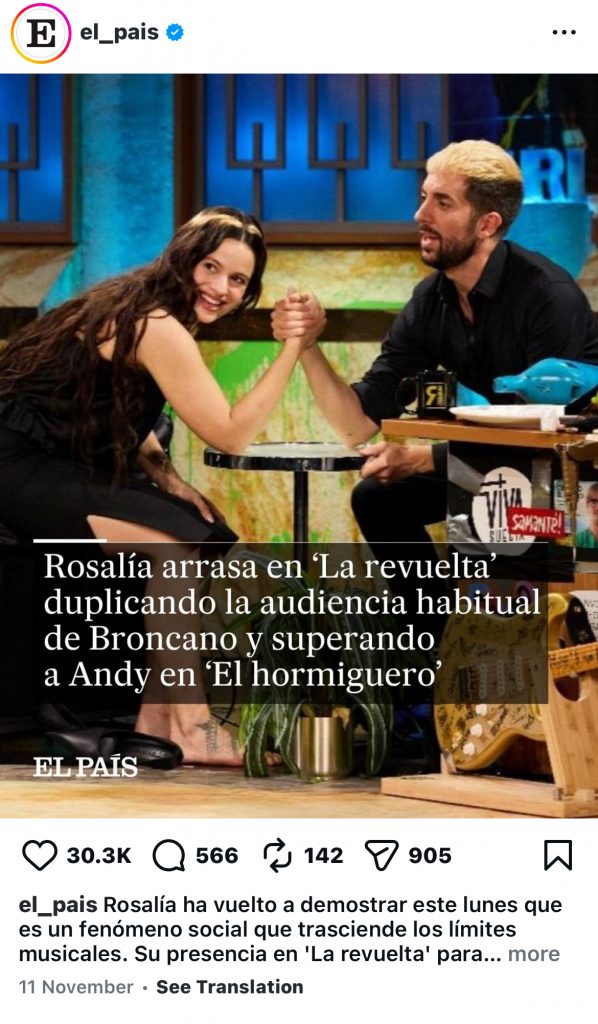
Take the rivalry between El Hormiguero (on Antena 3, owned by Atresmedia) and La Revuelta (on RTVE). Both air during prime time and compete fiercely for audience shares. Last year, RTVE bought La Revuelta from Movistar+ (a subscription platform) for a hefty sum, prompting right-wing outlets to accuse Prime Minister Pedro Sanchez of personally ordering the move to give left-leaning comedian David Broncano a prime-time slot using taxpayer funds.
What should’ve been harmless competition turned into a political and ideological war, fuelled by online outrage and partisan commentary. Right-wing El Mundo and left-leaning El Pais even posted nightly Instagram updates on who “won” the ratings war. It’s a perfect example of how both traditional and social media get weaponised – not to inform, but to monetise attention.
sparks of democratisation
Still, not everything is swallowed by commercial logic. Spain has seen the rise of smaller, independent outlets trying to resist it. The best examples is ElDiario.es, founded in 2012 by journalist Ignacio Escolar. Instead of relying mainy on advertisers, it runs on a membership model: readers subscribe voluntarily to support investigative journalism and gain early access, while content remains free for all.
Around 70% of ElDiario.es is owned by its journalists, giving it rare editorial independence. About 40% of its income comes from memberships, and the rest from carefully selected ads. The newspaper also publishes its financial statements annually – a level of transparency almost unheard of in Spanish media.
ElDiario.es embodies McChesney’s vision of media democratisation:
returning communication power to the people, promoting accountability, and rebuilding public trust.
is social media helping?
Some argue that social media has democratised traditional media by allowing users to comment, like, and share. But this is just surface-level democracy. Users merely react, not influence. Likes don’t determine editorial priorities or how stories are framed. The audience may feel part of the conversation, but we’re only talking among ourselves.
So, while Spain’s media looks plural, it’s still built on capitalist logic. There may be more voices than ever, but few are truly independent. Real democratisation isn’t about giving everyone a comment section; it’s about giving citizens genuine access to truth, accountability and choice.
Until then, Spain’s media buffet remains an illusion.
Leave a Reply